
Search has changed. Dramatically.
For years, businesses focused on one main goal: rank higher on Google. That was the game. You created a website, added the right keywords, published helpful content, built authority, and worked your way toward page one.
That still matters, but in 2026, getting found online is no longer just about traditional Google rankings. Your business also needs to show up in AI-generated answers, voice searches, map results, featured snippets, local recommendations, and conversational search tools like ChatGPT, Gemini, Perplexity, Copilot, and Google’s AI-powered Search experiences.
In other words, SEO is still important, but it is no longer the whole picture.
Today, businesses need to understand three connected but different strategies: SEO, AEO, and GEO, and yes, the acronym soup is getting ridiculous. Somewhere, a marketing department is very proud of itself.
What Is SEO?
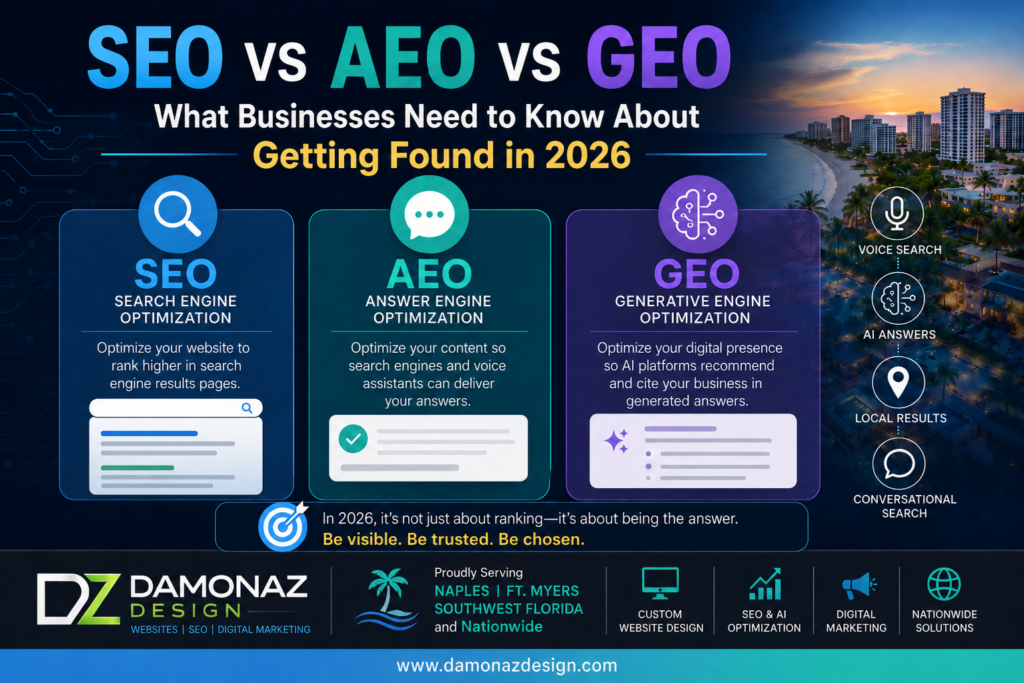
SEO stands for Search Engine Optimization.
This is the traditional process of optimizing your website so it appears higher in search engine results when someone searches for your products, services, or industry.
For example, if someone searches:
“website design company in Naples FL”
“digital marketing agency Fort Myers”
“SEO services Southwest Florida”
“custom website development company”
A strong SEO strategy helps your business appear in those search results.
SEO includes things like keyword research, website structure, page titles, meta descriptions, internal linking, mobile performance, page speed, quality content, backlinks, local SEO, Google Business Profile optimization, and technical website health.
For businesses in Naples, Fort Myers, Southwest Florida, and nationwide, SEO is still the foundation. Google has made it clear that its generative AI features are still rooted in core search ranking and quality systems, meaning solid SEO continues to support visibility in both traditional search and AI-powered results.
So no, SEO is not dead.
It just has roommates now.
What Is AEO?
AEO stands for Answer Engine Optimization.
AEO focuses on helping your business show up when search engines, voice assistants, and AI tools provide direct answers instead of a list of website links.
Think about the way people search now. They are not always typing short keyword phrases anymore. They are asking full questions, like:
“What is the best website platform for a small business?”
“How much does a custom website cost?”
“What should I look for in a digital marketing company?”
“Who offers SEO services near me?”
“Why is my business not showing up on Google?”
AEO is about structuring your content so it can be easily understood, pulled, summarized, and presented as the answer.
This means your website should include clear service pages, helpful FAQ sections, concise explanations, schema markup, strong headings, and content that answers real questions your customers are already asking.
AEO is especially important for businesses that rely on trust, expertise, and local visibility. If someone in Fort Myers asks their phone, “Who can help redesign my business website?” you want your company positioned as a clear and credible answer.
AEO is not about stuffing your website with robotic question-and-answer blocks. Please do not turn your homepage into a hostage note for Google.
It is about making your content easy for both humans and machines to understand.
What Is GEO?
GEO stands for Generative Engine Optimization.
This is the newer piece of the puzzle.
GEO focuses on helping your business appear in responses generated by AI platforms such as ChatGPT, Gemini, Perplexity, Copilot, and Google’s AI Overviews or AI Mode.
Instead of only asking Google and clicking through several websites, people now ask AI tools for recommendations, comparisons, explanations, summaries, and vendor suggestions.
They may ask:
“Who are the best web design companies in Southwest Florida?”
“What should I ask before hiring a website designer?”
“Compare SEO, paid ads, and social media for a local service business.”
“Give me a list of companies that offer custom website design and digital marketing.”
GEO is about making sure your business has enough clear, consistent, trustworthy information online for AI systems to understand who you are, what you do, where you serve, and why you are credible.
Generative engine optimization is generally described as the practice of structuring content and digital presence so AI-powered platforms can cite, recommend, or mention a brand in generated answers.
That means your website, service pages, blog content, reviews, local listings, social profiles, business descriptions, press mentions, and brand signals all matter.
AI tools are not just reading one page. They are looking for patterns of authority.
If your business has thin content, outdated pages, inconsistent listings, weak reviews, or unclear service descriptions, AI has less to work with.
And when AI has less to work with, it may skip right over you. Rude? Yes. Avoidable? Also yes.
SEO vs AEO vs GEO: What Is the Difference?
The easiest way to understand the difference is this:
SEO helps your website rank in search results.
AEO helps your business become the answer to specific questions.
GEO helps your business appear in AI-generated recommendations and summaries.
SEO is about visibility in search engines.
AEO is about direct-answer visibility.
GEO is about AI-driven visibility.
They overlap, but they are not identical.
A well-optimized website in 2026 should be built for all three. That means your content should rank well, answer clearly, and give AI tools enough trusted information to recognize your business as relevant and authoritative.
Why This Matters for Businesses in 2026
The way people find businesses is changing fast.
Google has continued expanding AI-powered search experiences, including AI Overviews and AI Mode, which provide more conversational and summarized answers directly in search. Google also announced major AI changes to Search at Google I/O 2026, including more conversational queries, AI-powered results, and agent-style capabilities that can help users complete tasks.
That means fewer people may follow the old pattern of typing a keyword, scrolling through ten blue links, and clicking one website at a time.
Instead, they may get an AI-generated summary first.
They may ask a follow-up question.
They may compare companies without ever visiting five different websites.
They may ask an AI assistant to recommend a provider.
This does not mean your website is less important. It means your website needs to work harder.
Your site is no longer just a digital brochure. It is a data source, credibility hub, sales tool, local ranking asset, and AI visibility engine.
That is a big job for something a lot of businesses have not updated since 2018.
What Businesses Need to Do Now
The best strategy is not choosing between SEO, AEO, and GEO.
The best strategy is building a digital presence that supports all three.
First, your website needs strong traditional SEO. That means optimized titles, headings, service pages, location targeting, page speed, mobile-friendly design, technical cleanup, and consistent content.
Second, your content needs to answer real customer questions clearly. This helps with AEO. Service pages should explain what you do, who you help, where you work, what problems you solve, and what customers should expect.
Third, your brand needs credibility signals that AI systems and search engines can recognize. This includes customer reviews, case studies, testimonials, portfolio examples, accurate business listings, consistent service descriptions, and content that demonstrates expertise.
Reviews are becoming especially important in AI-driven discovery. A recent Trustpilot analysis reported that businesses with stronger review signals were far more likely to appear in AI-generated responses, reinforcing how much trust and social proof matter in the AI search era.
For a local or regional business, this also means your location matters.
If you serve Naples, Fort Myers, Cape Coral, Bonita Springs, Estero, Southwest Florida, or clients nationwide, your website should clearly say that. Search engines and AI tools need geographic clarity.
Do not make them guess.
They are robots, not psychics. Although honestly, at this point, the line is getting blurry.
What This Looks Like on a Website
A modern website built for SEO, AEO, and GEO should include:
Clear service pages for each major offering, such as website design, SEO, branding, content strategy, digital marketing, app development, and AI business tools.
Strong local optimization for areas served, including Naples, Fort Myers, Southwest Florida, and nationwide clients.
FAQ sections that answer common customer questions in plain language.
Schema markup and structured data to help search engines understand the content.
Trust-building elements such as testimonials, reviews, project examples, awards, years of experience, and client success stories.
Fresh blog content that addresses what customers are actually searching for.
Consistent branding and messaging across the website, Google Business Profile, social media, directory listings, and other online platforms.
This is not about gaming the system.
It is about making your business easier to find, easier to understand, and easier to trust.
Why “Helpful Content” Wins
The businesses that win in 2026 will not be the ones publishing generic AI-written fluff.
They will be the ones creating content that is specific, useful, credible, and aligned with how real people search.
That means content should sound human. It should answer actual questions. It should explain things clearly. It should show expertise without sounding like a corporate instruction manual.
For example, a weak page says:
“We provide innovative digital solutions for businesses.”
A stronger page says:
“Damonaz Design builds custom websites, SEO strategies, digital marketing systems, and AI-ready content for businesses in Naples, Fort Myers, Southwest Florida, and across the country.”
That second version gives search engines, AI platforms, and potential customers something useful.
Specific beats vague.
Clear beats clever.
Helpful beats hype.
Every time.
Local Businesses Need This Even More
For local businesses, the shift toward AI search makes digital clarity even more important.
When someone searches for a company near them, AI tools may consider your website, reviews, Google Business Profile, location data, service descriptions, online mentions, and overall authority.
If that information is incomplete, inconsistent, or outdated, your competitors may appear instead.
For businesses in Southwest Florida, that means local SEO is still critical. Naples and Fort Myers are competitive markets, especially for professional services, construction, real estate, hospitality, health, legal, home services, and luxury-focused businesses.
If your website does not clearly communicate what you do and where you do it, you are making your customers work too hard.
And customers do not want a scavenger hunt.
They want answers.
The Bottom Line
SEO, AEO, and GEO are not separate trends. They are part of the same bigger shift.
Search is becoming more conversational, more AI-driven, and more focused on direct answers.
Businesses that adapt now will have a major advantage.
Businesses that ignore it may still have a website, but fewer people may actually find it.
In 2026, getting found online means your business needs to be visible in search results, answer engines, AI summaries, local recommendations, and generative platforms.
That starts with a strong website, clear messaging, optimized content, trusted authority signals, and a digital strategy built for how people search now.
Damonaz Design helps businesses in Naples, Fort Myers, Southwest Florida, and nationwide build smarter websites, stronger digital visibility, and content strategies designed for the future of search.
Because the goal is no longer just to be online.
The goal is to be found.
