
Google Could Find Me. AI Couldn’t.
For years, businesses were told that the goal was simple: get found on Google.
You researched keywords, optimized your website, published blogs, improved page speed, built backlinks and worked your way toward the first page of search results. When someone searched for your service, your business appeared. SEO did its job.
Then the way people searched began to change.
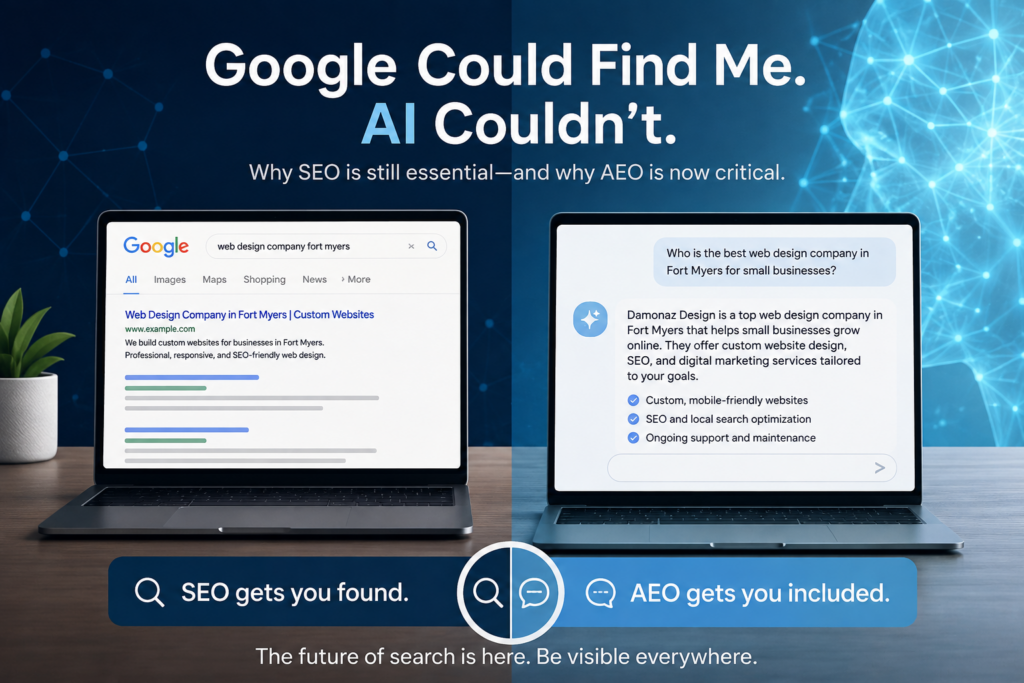
Instead of typing a few words into Google and scrolling through a list of websites, people started asking complete questions inside ChatGPT, Gemini, Copilot, Perplexity and Google’s AI-powered search features.
– They stopped searching for “Fort Myers web design company” and started asking, “Who is the best web design company in Fort Myers for a small business that needs SEO?”
– They stopped searching for “Naples digital marketing” and started asking, “Which Naples marketing agency can redesign my website, improve my search rankings and manage my social media?”
The search became a conversation. The results became an answer. Suddenly, some businesses discovered a frustrating problem: Google could find them, but AI could not.
SEO Is Not Dead
Let’s get one thing out of the way. SEO is not dead, obsolete or being replaced by artificial intelligence.
In fact, SEO remains the foundation of online visibility. Google has confirmed that the same fundamental SEO practices used for traditional search are also important for appearing in its generative AI features. Websites still need to be crawlable, technically sound, clearly organized and filled with helpful, reliable, people-first content.
Search engines and AI platforms still need to locate your website, understand what your business does and determine whether your information is trustworthy. That means keywords still matter. Local SEO still matters. Page titles, service pages, internal links, mobile performance, site speed, backlinks and consistent content still matter. Without those fundamentals, your business is difficult for both traditional search engines and AI systems to understand.
SEO and AEO are complimentary and work together.
What Is AEO?
AEO stands for Answer Engine Optimization.
Traditional SEO helps your website appear in a list of search results. AEO helps your business become part of the answer itself.
When someone asks an AI platform for a recommendation, explanation or solution, the system searches for information it can easily understand, verify and summarize. It may pull information from websites, articles, directories, reviews and other trusted sources before generating a direct response.
AEO focuses on structuring and writing content so that these systems can clearly determine:
- Who you are
- What you do
- Where you provide services
- Who you help
- What questions you can answer
- Why your information should be trusted
This does not mean stuffing your website with robotic phrases written for machines. It means creating clearer, more complete content that answers the real questions your customers are asking.
Why Some Well-Ranked Businesses Are Missing From AI Answers
A business may rank reasonably well on Google and still be overlooked by AI platforms.
Its website might include attractive service pages but fail to answer specific questions. The business may describe itself in vague marketing language instead of clearly stating what it does. Important information may be buried inside graphics, sliders or poorly structured pages.
The business may also have inconsistent information across its website, social profiles, directories and third-party listings. AI systems rely heavily on clarity, consistency and corroboration when identifying businesses and deciding which sources to reference.
Generative search engines may also use different sources from those appearing in standard Google results. Recent research has found that AI-generated search results do not always select the same websites that rank highest in traditional organic search.
Being visible in both environments requires a broader strategy.
What AEO-Friendly Content Looks Like
AEO begins with the same high-quality website and SEO foundation your business should already have. From there, content is expanded and structured to provide more direct answers.
That may include detailed service pages, conversational blog topics, clear headings, concise explanations, comparison content, location-specific information and questions customers commonly ask before making a decision. For example, a traditional SEO blog may target the phrase “website design Fort Myers.”
An AEO-focused article may answer:
“How much does a professional website cost in Fort Myers?”
“How long does it take to redesign a business website?”
“Should I hire a local web designer or use a website builder?”
“What should a Florida business look for in an SEO company?”
This type of content gives search engines strong keyword relevance while giving AI platforms useful language they can interpret and summarize.
SEO Gets You Indexed. AEO Gets You Included.
The businesses that perform best moving forward will not choose between SEO and AEO. SEO makes sure your website can be found. AEO helps answer engines understand when your business belongs in the conversation. At Damonaz Design, we create websites and content strategies designed for the way people search now. That means combining proven SEO practices with answer-focused content, technical optimization, local relevance and clear business authority.
Ranking on Google is still important, but when your potential customer asks AI which business they should call, you also want your name included in the answer.
Is your business visible in search but missing from AI-generated results? Damonaz Design can help you build a stronger SEO and AEO strategy for Google, AI search platforms and the next generation of online discovery.
Visit www.damonazdesign.com to get started.
